Showing posts with label tuffoldjock. Show all posts

Shoes Should Fit Your Body, Not Just Your Feet

When buying a new pair of running shoes, the challenge is to find a pair that fits your body, not just your feet. It took me a long time, and lots of shoes, to realize that it wasn't enough that the shoe felt good on my feet in the store, but that my entire body felt good many miles later.

A good shoe is the most important purchase a runner makes, and that's even more true for a TOJ who needs good protection because his/her body already has wear and tear. I've never scrimped on running shoes and have owned over a hundred pair. Many of them have ended up barely used at a bargain price in a Goodwill store, and, hopefully, on the feet of somebody for whom they were perfect. Even after years of running, finding the best shoe takes some study and luck.


The comparative performance ratings in the running magazines and online are getting better and better at objectively assessing some of the important differences that exist between shoes. As one who ran in the Adidas Cross Country and early Nikes with a black rubber waffle sole, I can attest that all the engineering and materials in today's shoes have really improved their durability and performance. The innovations in new shoes are not all marketing hype. I use the ratings to pick out a half dozen or so promising candidates, if I'm ready to take the risk of a model or brand change.

But I also try to ignore the lure of the hot looking shoes on the lean and mean (10K, marathon, ultra, whatever) superstar in the ads showing him or her triumphantly breaking the finish ribbon. I (or likely you either) don't belong in that shoe because I neither run nor am physically like the guy in the ad. And though the zippy graphics on his shoes are cool, they won't protect me in steep, rocky and remote terrain.

Of course, you have to do the in-the-store drill. Put on socks of the same weight and material in which you prefer to run. Try on both shoes. Lace them just as you would when you are going to run. Check that there's a about 1/4 thumb of space between your toes and the end of the shoe. Check that the heel cup is snug but not tight, and that your forefoot doesn't float sideways and isn't cramped. Walk then jog around the store (or outside if allowed) to see if there are any spots that rub (even a little bit!), if you feel stable, and adequately cushioned the full length of the foot, especially under the arch. If they feel close-to-perfect, congratulations, there's a chance they might work.


You may not really know if the shoes are right for you until you've run anywhere from 1 to 50 miles. I've had shoes that made me slightly change my gait. My feet felt fine, but during the run I would notice something didn't feel right, like I wasn't centered over the shoe or I needed to run slightly pigeon-toed to get them to roll properly trough a full stride.

Even small changes in the way you naturally run can cause a repetitive motion injury that manifests elsewhere in your body. While running, your whole body is rewarded or punished by your shoes. Even a couple of degrees of change in the angle a shoe engages the road or trail surface can radiate out of the feet to the knees and hips. If you start compensating by adjusting your stride by moving your pelvis or arms more, you can aggravate your shoulders and neck, which are a long ways from where your feet pound on the earth. Sometimes you don't even realize it until you feel pain after a hard run.

I bought a pair of North Faces, which felt great in the store. They hugged my foot like a glove and were grippy on the loop I ran around the store. After I bought them, they weren't bad on the trails either for the first part of a run. But after running for a half hour or more, I had low level pain pulsing through my legs, and not in the usual places. I'm a stocky runner who has had an ankle injury and both knees scoped. I expect a little discomfort there. Some soreness, especially in muscles, is to be expected after a long run. To me, it's a pleasant reminder. But I was feeling some pain in my thigh bones and hips joints, too. The shoe just wasn't offering enough cushioning or holding my foot laterally stable. I concluded it might be a good shoe for a lighter runner, but not for me most of the time. I now reserve them for short runs on softer surfaces, where they do fine.

I also have a pair of Montrails that felt a little clunky in the store and a bit roomy in mid-foot. I wasn't sure about them. But the heel absorption felt right and the sole very firm. I gambled and bought them. For the rocky trail where I run often, they work very well. They fit snug enough on my foot, and, more important, they fit they way my body runs. my weight, and the terrain. At the end of the run, my feet and the rest of my body, feel tired and a normal post-workout sore, but there's no unusual pain. That tells me I'm in the right shoe.

Yet my Montrails, like any shoe, have their limits, too. A good shoe may work on one surface but not on another. With the Bolder Boulder 10K coming up, a few months ago I started running once a week on an asphalt country road. Running on mountain trails and asphalt roads is very different, not just because of the difference in hardness of the surfaces. Running trails with steep ups and downs strengthens your legs, but it also shortens your stride length -- not good for a road race. I've also found from wearing a heart rate monitor that I tend to work at a higher rate on flat roads than going up a hill. Road running presents much less variation to the body. So to get ready for the Bolder Boulder, I try to get acclimated to the asphalt and find a mile-by-mile sustainable pace, which is impossible to do with the ups and downs on a mountain trail.

The first couple of times I ran on the asphalt during late winter in my Montrails, I felt crappy. My entire skeleton ached, as did my toes and the middle of my feet. It didn't help that the county went cheap on road maintenance by capping it with 3/4 inch gravel, making a surface that is tough for runners and bikers. On that hard, abrasive surface, the Montrails felt like I was running on short slabs of 2x4, and 10K seemed like a long, long ways. Something was wrong.

I wondered if the problem was due to my shoes. I happened to be in Boulder, Colorado, and went into the Boulder Running Company, a runner's mecca. A nice young woman asked me what I was looking for, how many miles I was running, etc. It was nice to have a store clerk take a TOJ like me seriously.

I told her all about what was going on. She asked me to take off my shoes and socks, then stand evenly on both feet. She told me I had a little over-pronation. After getting my size, she disappeared into the stock room and came back with three pairs of shoes, all of which felt good at first touch. She insisted I take each of them out of the store for a run. I followed her advice and returned sweaty and sold on a pair of Saucony's, a brand I have never owned before. They have made the runs on asphalt much more tolerable, sometimes even pleasurable, and I eagerly anticipate what they will do on the comparatively smooth streets of Boulder. The knowledgeable clerk reminded me of why it's always best to buy your shoes in a speciality store. You want to buy your shoes from someone who loves running as much as you do.

My body has taught me a lot about how to buy running shoes. Thirty years ago I made the right pick about 20% of the time. Now I guess correctly more than 60% the time. It's good the odds are getting so much better because, as a TOJ ages, the physical stakes get much higher. And the return on investment good shoes give me by keeping me on the trail and out of the doctor's office is better than I'll ever earn in my IRA. I figure I better buy more running shoes to save more money.




Don't Judge a TOJ by the Size of His/Her Shorts

On the Fourth of July over thirty years ago, I was at the start of a five mile race on a then-dirt road that runs along Horsetooth Reservoir, just outside Ft. Collins, Colorado. I had lined up in the second row behind the really fast people wearing singlets and skimpy dayglo shorts. Although I was in good shape and expected run the hilly course in pretty good time, I wasn't a serious racer with any expectation of placing, especially with some of very competitive local runners I recognized in front of me, including one who would soon be one of the top 10K road runners in the U.S.

One guy caught my eye when he took up a position almost right in front of me because he looked like he didn't belong there. He was large, with tent-like baggy shorts and ridge of fat bulging from under a x-large T-shirt. I wondered if he was arrogant or just plain ignorant lining up where everyone most of the field would have to run around him in the first hundred yards.

But when the starting gun fired, he pulled away from most of us and quickly disappeared over the first hill, with the lead pack, in a cloud of dust. By the time I crossed the finish line, he was relaxing with some other early finishers, laughing and drinking a beer. Later when they announced the results, I found out he had finished fifth. He had come within a minute of the winner, the guy who would go on to national fame and a contract with Nike. The heavy mystery runner had come from somewhere up in Wyoming. I never saw him again, but I never forgot him.

I thought of him when I picked up a book called Shape Up with the Slow Fat Triathlete by Jayne Williams, a large athlete who has weighed upwards of 240 lbs. and has also completed over twenty triathlons, among her other athletic accomplishments. I enjoyed her book for lots of reasons. Although it talks most directly to women, the book is full of useful facts and suggestions on training, attitude, competition, clothing, nutrition, and health. With humor and light heartedness, she addresses everything from Lycra and energy gels to hydration and the color of healthy urine. Her words have the authentic ring of experience; when she describes a greasy concoction to help avoid rubbing your butt raw on a bike seat during a long ride, you know she has been there, done that. The core information is pertinent to athletes of all ages and genders, including TOJs.

But it's not the facts that drew me to her book. It was because she conveys such a deep and abiding love for exercise that is shared by every TOJ. Reading her insights, you realize she has fought personal and physical battles to be athletic, starting with being a heavy woman in an body image-obsessed culture and rising to the real challenge of moving that body with skill in one of the toughest endurance competitions. The simple laws of physics dictate that a heavier runner will expend more energy and effort to cover the same distance as a flyweight. And the heavier runner will endure exponentially higher forces on his or her joints, especially the knees.

"Heavyset" and "endurance sports" seem to be concepts that are at odds, but Jayne proves that is just conventional (and wrong) wisdom. Exercise is fun and good for everyone. People of all shapes and sizes love it and have a right to participate in any pursuit they choose. Much of what she has to say about heavy athletes is true for TOJs as well. Until very recently, it was an unspoken rule that as we age, we become less active, as if all there is to do when your hair turns grey is to voluntarily resign yourself to a sedentary life of checkers, knitting and television. The cultural signals are all around us. When you pick up a copy of Runners World, you will never see a heavy runner, nor will you ever see a TOJ.

Jayne Williams gets it -- you pursue your physical passions for your own reasons, whether it's a race or a jog in the park. You will likely never win anything. You may never look sleek or strong. Physical effort might be hard for you and sometimes you might get injured. Other times you will become tired and lazy. Sometimes you train like a Spartan and watch what you eat, other times you eat like a pig. The athletic life is dynamic because your body, the weather, the terrain, skills, techniques, equipment, everything is constantly changing. It's what you have chosen to do, despite all odds. It's how you fill your time, like a Zen master sits on a cushion and stares at a wall.

And after all is said and done, Williams, like a TOJ, feels a great sense of joy, humility, and gratitude. In a book with many memorable lines, my favorite reads: "Simply being able to move your body around is something that should make you feel awed and grateful every day." To that, this TOJ would only add: Amen.


Moabing in Moab, Utah

Moab, Utah, lays in a narrow, north-south valley sandwiched between the foothills of the La Sal mountains and the Moab Rim, a red mass of layered sandstone rising a thousand feet above. The core of the town consists of twenty or so blocks strung along State Highway 191, a two lane that is busy 24/7 because few routes go north and south in Utah, where the middle of the state is dominated by some of the most rugged and spectacular geography in North America.

When you drive in miday, you are in a procession of semi-trucks pulling mining contraptions, SUVs bristling with hard core mountain bikes or kayaks, long shiny campers with nicknames like Wanderlust , Subaru Outbacks packed with camping gear, hugh pickups hauling a trailer with multiple-ATVs, and battered pickup trucks loaded with hay. You pass a hodgdepodge of rock shops, motels, motorcycle shops, mountain bike shops, junk food and organic food restaurants, the obligatory Native American arts and crafts store, and a funky store with crystal curtains that looks like head shop.


The mix of hand-painted and neon signage gives you the feeling that the zoning rules are pretty lax, hinting at a frontier, libertarian bent, not the strict order you'd expect in a place with such deep Mormon roots. This may be a resort, but it ain't fru-fru; you won't see any Aspen Insitutute or Sante Fe Ballet here, or meetings of the World Bank. Moab can be very hot, windy and dusty and freezing during the winter. Like all places with a view in the West, some fancy second homes have popped up in the last decade, but not many. Probably too hard to keep them clean, and there is only one golf course.


I first learned about it many years ago from Edward Abbey in Desert Solitaire, in which he described the austere beauty of the canyon country and high desert. After reading about it, it took years to finally visit, but once I did, I've been drawn to it ever since. And when in Moab, I always pay a visit to Back of Beyond Books, which has a great collection of Abbey books (and sort of a shrine to him when you first come in the front door), maps, hiking and biking books, environmental books, and western history.

Moab epitomizes the two cultures that co-exist, with varying degrees of success, in rural resorts in the West: the nature lovers and adventurers with mountain bikes, rafts, and hiking shoes and the motor nuts with ATVs, monster wheel jeeps, and motorized trail bikes. Moab has large and well organized contigents of both. You might say it gives Moab some economic diversity. I think the two cultures get along fine because most visitors don't spend that much time in town, and there are vast expanses for the two cultures to avoid each other. You want to avoid Moab during the annual Jeep Safari in April when the town is overrun by every 4-wheel congifuration known to man. They caravan up every nook and cranny and have contests to see if they can crawl over steep rocks without rolling down. When they roll down and smash their rigs, they then spend all night outside your motel room drinking Bud Lite and welding the broken pieces back together. They next day they head back to the slickrock, leaving smashed beer cans and pools of oil and grease all over the parking lot.

For a TOJ, most times of the year Moab is a paradise. There is great trail running and mountain biking. Moab is best known for the Slick Rock Trail, which is very challenging and, except for the most skilled and well equipped TOJs, potentially dangerous. On some days the Slick Rock Trail feels as crowded and hyper as Breckenridge ski resort on Xmas day. But there are hundreds and hundreds of miles of trails and roads both in the national parks and other public areas outside of Moab. I've found the Falcon series of hiking and biking books very reliable, as well as the Latitude 40 maps, which you can online at http://www.latitude40maps.com/ or find in many outdoor gear shops.

You spend limited time in Moab because it's a long drive into Arches and Canyonlands, truly among the wonders of the world. There is so much to see and do outside the town, which is why you go there, and travelling back and forth consumes most of your day. But Moab is a perfect base camp for your adventures, and you can still enjoy resort amenities like good food (try the Peace Tree for wraps and smoothies or Miguel's Baja Grill for Mexican food) or good beer (try the Moab Brewery).

Moab is a place that deserves to be a verb. It's a place where you go to do things in the outdoors, not just hang out. We just visited there for a few days. I got to run on a back road in a howling wind that drove red sand into my ears, mouth, and eyes, and to wander amidst the towering slabs of Entrada Sandstone in Arches that make you think about deep time. It was great. I was Moabing.


Not Too Much, Not Too Little -- Part 2

Back in January, I wrote, "If some exercise physiologists and medical researchers are right, the risk to a TOJ's long term health due to over-exercising is much higher than just catching a head cold, a topic to explore in my next blog." Okay, it turned out to be a few blogs later. Here it is:

There are friends and enemies of prolonged endurance exercise. The friends sometimes oversell it and understate both some of its risks, as well as the advantages of other types of exercise.

The enemies, like Al Sears, MD, who promotes intense short, interval training in his PACE Program, or Lou Schueler et al, who advocate that healthy exercise consists of building buff bodies with weight lifting in books like The Testosterone Advantage Plan, like to demonize conventional cardio/endurance exercise. What is odd is the militant tone of these opponents of aerobic exercise, especially against running. Scheuler almost gloats about the unfortunate death of Jim Fiix back in 1984, who wrote the then definitive book on running. Fiix had a family history of heart disease and was a former smoker who took up running in middle age. My hunch is that most enemies of endurance sports feel that way because they are either not very good at it, so it feels like pure drudgery, and they have never experienced the endorphin high that hooks you like a dope addict.


It is true that sometimes endurance athletes die suddenly. For over thirty years, sports science has been aware that many highly trained endurance athletes have over-sized hearts and, often, irregular heartbeats. These irregularities were often the usual suspect when an otherwise healthy endurance athlete keeled over dead. But heart size is no longer considered the problem as it once was. Lance Armstrong has a hypertrophied left ventricle that makes his heart one third larger than the average person and can pump at 200 beats a minute, no problem.

As a friend of endurance exercise, I was concerned when I heard that Alberto Salazar, the great marathoner, suffered a heart attack (but again, a long family history, and already diagnosed risk factors) at the Nike training center in Oregon a couple years ago. Or when I read in Runner's World that Rich Trujillo, an fifty-something runner who has accomplished amazing track and trail running feats over decades, has had a heart bypass operation. And he still runs, a true DTOJ, double-tuff old jock.

You have to wonder if the real underlying cause of their heart conditions is what I first mentioned in the January blog -- chronic inflammation. Ironically, running is likely what has kept them alive, although they were unknowingly setting the stage for future problems. They ran often and ran hard at the highest competitive levels. Years ago, Ken Cooper, M.D., the father of the aerobics movement, noticed that an unusually high number of elite athletes were coming down with illnesses, sometimes very serious ones like cancer.

In recent years, exercise physiologists have been studying the sad phenomenon where athletes train harder and harder, yet their performance gets worse and worse. They have given the condition a name: Overtraining Syndrome (OTS). The subtle physiology of the condition is fascinating, and the net result of the cascading electro-chemical events in the body is inflammation.

The syndrome starts when an athlete over-reaches, that is, tries to exercise faster, longer, or more
frequently than their fitness level is ready to handle.

If you are interested in a good discussion for the layperson, Gretchen Reynolds wrote an excellent article about OTS in the New York Times. Just go to:

http://www.nytimes.com/2008/03/02/sports/playmagazine/02play-physed.html?ref=fitnessandnutrition&pagewanted=all

And if you are interested in the the hard science of OTS, go to:
http://www.woongbee.com/Cytokine/Cytokine%20bulletin/Spring%202001/spring2001-4.htm

So, you wonder, what does OTS have to do with TOJs, who are not elite athletes? TOJs work out hard and often, too. As you age, you are more prone to the very same fatigue and inflammation as the best. TOJs are exercise nuts, so they are predisposed to OTS. It's all relative. Where 100 miles a week might push an elite athlete into the inflammation zone, it might only take 30 miles a week to do the same damage for a over-zealous TOJ.

Or maybe you are one of the one in a million who do not develop inflammation, like ultra-runner Dean Karnazes. He ran 50 back to back marathons, one day after another, with no rest period between days. After the 50th, they drew some blood to measure the effects on his body from such an extreme effort. All the markers of inflammation, like cytokines, were absent.


The good news is that inflammation can be avoided or controlled by three factors every TOJ needs to understand: 1) rest and recovery, 2) the right foods at the right time, and 3) knowing when you are over-reaching.

More on each of those is coming soon. But first it's off to Moab...


Running Over, Around and Through the Recession

Whether you are looking for work, renegotiating your mortgage, reallocating your IRA, haggling with your creditors, or personally okay but worried about your family and friends, find the time to run more and run harder.

One of the worst things about economic chaos is that it makes you feel like you have lost control of your life. Maybe you've lost your job, or your retirement, or your house. Or economic events are going to force you to make difficult business decisions or career decisions you dread. But you own your body, and can still put one foot in front of another. Every step you take is a reminder that you have more control than you realize. Running empowers you.

Economic problems are stressful for you, your family, friends, co-workers, and neighbors. Running will pump endorphins into your brain and help you chill out. You will sleep better. Your body will produce less cortisol and adrenaline. As you go about your day more relaxed, you will help those around you relax. Your peace will breed peace in those around you. The Buddhists have understood that for over two thousand years. The Old Masters would be runners today.

Running allows you to escape the incessant negativity of television. TV thrives on drama, tragedy and conflict. Unfortunately, pessimism is contagious, and the constant bombardment of the angry talking heads breeds fear in anyone who watches it. Peace and quiet don't work on the tube. It's a puny, square, distorted window on a big, multi-dimensional world that can only hold your attention with loud noise, canned laughter, and extreme views and behaviors. Running puts you in the real world where you listen to your own thoughts and the reality around you.

And while you are away from the TV, you will also escape all the ads telling you that you need to go buy something to overcome a personal shortcoming, satisfy some craving, keep up with the Joneses, and achieve happiness or faux security, whether or not you have the money to do so or it's really in your best interests. During a recession is a good time to take a break from it. TV doesn't know you and cares about you only as a customer.

Running keeps you healthy, thus lowers your healthcare costs. Medical costs are the major cause of personal bankruptcies. During a recession, more and more people are uninsured. If you are behind on your mortgage or out of work, the last thing you need is to pay more money to a healthcare system that already consumes more than any other industrialized country on earth. Plenty of reliable evidence shows that regular, moderate exercise helps prevent numerous chronic diseases like hypertension, diabetes, cancers and a host of other degenerative conditions. With every step, you protect your health and assets at the same time.

You need to think clearly because you are faced with difficult decisions, irrational fears, and an unstable, shifting economic environment. When you run, your brain will produce brain-derived neurotrophic factor (see Harvard psychiatrist John Ratey's Spark: The Revolutionary New Science of Exercise and the Brain), which actually makes you smarter and more creative. You will be armed with the best weapon a human has to cope with adversity: a high-functioning mind. You are better able to see the Big Picture and find solutions, rather than get stuck in the problems of the moment. Some of your best thinking happens while you are running and not fretting. You are in the present, where problems vanish as you struggle to keep a pace, breathe, and ignore the growing pain in your legs.

Finally, running is cheap. Cheap is good if you are broke or need to hold on to your savings in case you are going to be out of work. All you need a good pair of shoes, you can skimp on everything else. You don't need to spend money on a gym, exercise DVDs, or fancy home equipment or fru fru lycra with dayglo trim. You can just step outside of your door, lace 'em up, and go.

Out on the trail, you will run over, around and through rocks, stumps, downed timber and streams. You'll go up, down, then up again. You see the world is alive and constantly changing, everything is passing by. The recession will pass too.


----------------------------------------------------------------------------------
Note: What is true of running is also true of biking, hiking, swimming, rope jumping, rowing -- whatever you do hard enough to elevate your heartbeat for thirty minutes or more each day. Running is my favorite. Follow your own bliss.

Mud: Sacred Rite of Spring

March 1. When I started up the trail in early Sunday morning, it was still close to freezing, but my running shoe cracked through a thin layer of frozen crust into a couple inches of red mud. It was a thrilling sensation, a sure sign of Spring.

All week the temperature was in the 40s, melting down the snow that has covered the trail for almost three months. It's been a grey winter, not that cold, but plenty snowy. I keep a half-assed journal of my runs with elapsed time, temperature, milestones along the trail, and sometimes heart rate. I have plodded over light powder, snow mobile-packed corduroy, deep wet cement, ice and rotting crust, in rain-snow mix, blizzard conditions, graupel squalls and clear, frigid air. The coldest run was 9 degrees. The only sound on most runs was the wind or caw of a raven.
Once when the snow was falling hard, it was like running through a silent white tunnel. It reminded me of a short poem Basho wrote in the 12th century in "Narrow Road to the Deep North":

Deep as the snow is,
Let me go as far as I can
Till I stumble and fall,
Viewing the white landscape.

I love winter, but the short, dark days get old. Seasonal affective disorder (SADS) and cabin fever aren't imaginary. Going to work in the dark, coming home in the dark makes you want to hibernate, but you can't. Unlike a bear, it's not in your nature. The dark makes you want to go to bed too early and sleep too long. Some part of your brain remembers the warm Africa Savannah where we originated a long, long time ago. Your body longs for sun and warmth.


The animals feel the spring change too. I smelled a skunk, and cattle are calving on the ranch below. The small birds, like Chickadees and Towees, are coming back. I heard them for the first time, flitting in the bushes. Here and there small herds of deer foraged amid the sweet smelling sage in patches where the snow is gone. Soon they will go back up to the high country because the sun will beat down, making it too hot for them. But today, it is just right. In the warm sun they relax a little. Every warm-blooded mammal gives a sigh of relief.

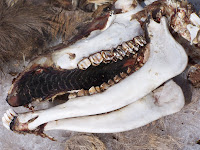
It was a hard winter for the deer and elk. There are signs of winterkill, bones left along the trail, pieces of shrunken, torn hide. The coyotes have been scavenging. Most deer and elk die from hunger and the cold, a few from mountain lions and poachers. Coyotes don't do most of the killing, but much of the cleanup. The Navajo say, "Coyote waits. And coyote is always hungry." They are opportunistic, just like us.

A tuff old jock offers this poem for you:

Ah...Spring
Skunks, birds, sage,
the snow reveals its bones.
The Great Wheel of Birth and Death
turns silently again,
my running shoes are muddy.
PS: Go to tuff old jock on Facebook and join the tuff old jock group. It's painless and free. You will find exhilaration, inspiration and motivation.