Showing posts with label trail running. Show all posts

Flopping Like Lebron

TOJs can learn something important from Lebron James, a remarkable basketball player and athlete - how to safely fall.


In the NBA flopping refers to the practice of intentionally falling down to try to draw a foul. Lebron James recently got fined $10,000 (the equivalent of $1 to the rest of us) in a playoff game for an awesome flop.

The video below shows Lebron doing a series of flops. Watch carefully and notice as he goes down how he first slows the fall by reaching out with his hand and relaxes and rolls his body, when possible, as he hits the court.


Also watch flop #1 in the link below. His body is flexed, not rigid. Yes, that's an incredible display of reflexes and strength, much more limited in a TOJ, but the principles remain the same.

http://www.businessinsider.com/lebron-flop-gifs-2013-5

This TOJ has talked about why it's important to know how to fall before.  It's only slightly less  important than knowing how to swim because it can help avoid serious injuries.

I'd run across some of these Lebron clips over a week ago. Seeing him flop reminded me I had't practiced falling in awhile, so after a workout, I got on my knees and took a couple of forward and sideways falls onto the mat. I practiced just like Lebron, reaching out as I approached the mat, dropping to my hip, and lightly rolling onto my shoulder.

Ironically, just yesterday I was out for a nice run on the Deschutes River Trail. The temperature was just right and I was feeling energetic, though starting to fatigue after over 40 minutes into the run. I had just passed through a rocky section, where I was careful, and picking up the pace when my right toe caught on a small rock I didn't even see. Down flew this TOJ with a groan and a cloud of dust.


It could have been much worse. Because I'd had some recent practice, I got my left hand down and mimicked Lebron. The left knee shared the force with my entire left side as I rolled across the dirt.

Severe injuries happen when all the force goes to one place, as when the hip hits first. I was able to avoid that, though my best running shirt got trashed.

TOJ's dont need to go slamming themselves against the ground. But some practice and physical training makes all the difference.

The physical training part is very basic. You get in the upward position for a push up and then descend very slowly towards the ground. Think of it as a push-down. This is an eccentric muscle action where you are decelerating. The ability to quickly decelerate is the secret to agility. Work up to sets of 15 reps a couple times a week.

Also do some yoga cobra poses and hold them for a minute. Throw in some side planks as well. You never want to fall with your arms locked as in the side plank, always have the elbow slightly bent. However, the plank will strengthen your core, which help keep everything supported when you hit the ground.

At least you'll be able to flop like Lebron, even though you don't get paid as much for doing it.


Get your FREE copy of my book, The Wellness Club: A Journey To Health Beyond Healthcare.

Just go to Smashwords. At checkout out enter Coupon# WD77M.

Right Run, Wrong Shoes

A running shoe is just like a tool - you need the right one for the job. Today, quite by chance, I ran in a shoe that didn't match the job. Now my feet and ankles are a little sore. But it's not the shoe's fault because I ran on them in conditions for which they weren't designed.

Where I live, it's the mud season. The last of the snow is just melting off my favorite mountain trail which is a few miles from our house. Sometimes when the snow or mud is too deep, I'll run with my wife on the asphalt road in the valley where the trail takes off. There's a parking area. I head up the trail, she runs up the valley on the asphalt.

Today I figured it would be that kind of day because it snowed and rained last night. The trail was bound to be super muddy, so I laced on a pair of Saucony Pro Grids, a good shoe for asphalt because of its cushioning. But when we got to the parking area at the base of the trail, the road up looked not too bad. The warm air and a slight breeze had dried some of the mud. I couldn't resist the call of the trail and headed up.

The first stretch wasn't bad because it climbs and faces slightly south. It had dried pretty well for the first eighth of a mile and some ATVers had packed a couple of ruts, but when I got to the first flat stretch there was mud and the ruts deepened. I tried to run at the edge were the dirt was drier, but in many places the mud was unavoidable.

Two thirds of the way up the trail, the trail becomes more rocky. There was still patches of snow and the Saucony's would slip there, too. I recalled winter runs on my Vasques which are stiff and have big lugs on the soles. Some might consider them clunky, but in snow, which is all I use them for, they are very sure-footed. They grip and hold my foot level, even when on the side on an incline, just like the edge of a ski.

And on the rocks, the Saccony's, slipped, twisting my feet, and I could feel their hard edges of the rocks stabbing into the bottoms of my feet. I had to laugh because the trail was beating the hell out of me.

I thought about some of the shoe ads I just had been reading in Runner's World, just before I went on this run. Ever since the huge success of McDougall's Born to Run, which launched the bare-foot running craze, the shoe manufacturers have been madly engineering a new breed of "minimalist" (their word) shoes. They tout that they are lighter and the heel is closer to the ground so you can "feel" it. I guess this is what they have identified are the key features of the huaraches the great native trail runners in Copper Canyon down in Mexico run on.

Looking at those ads, my Sauconys don't look that much different. The hot new shoes look flashy, but too skimpy for running in the Rocky Mountains. Sometime I'll give a pair a try. A TOJ needs to be open minded. I think within a year or two, there will be lots of clearance sales for these minimalist designs.

Meantime, the run was still awesome. There's nothing like sun, mud, and melting snow. I'll wash up my Sauconys so they are ready to go on the asphalt where they belong.

Exercise Junkies in the Great Outdoors

At the invitation of some friends, last night my wife and I attended the 5 Point Film Festival in Carbondale, Colorado, featuring new adventure films about extreme kayakers, mountain climbers, snow boarders, skiers, surfers, mountain bikers, base-jumpers, and trekkers. It was the third day of a four day festival, and all the films and trailers we saw were extraordinary in their cinematography, breath-taking scenery, and death-defying (mostly) human feats.

Sort of like when a human looks at an ape at the zoo and feels a vague sense of kinship, outdoor fitness enthusiasts, which includes many TOJs who trail run, bike or mountain bike, recognize some commonality with these adventurers. We are all physical junkies. And to survive the stunts shown in the festival -- snowboarding down 55 degree mountain faces, kayaking over 100 ft waterfalls, climbing ropeless up 2,000 ft of vertical rock -- require world class athleticism, reflexes and endurance, well beyond what most of us will ever achieve.

Yet, in basic ways, we are very different. For us, extreme danger is an exception, not an end in itself. We risk failure at meeting a physical goal, like running a certain distance or lifting a certain weight. Sometimes danger finds us anyway, like when we get lost or our bodies are over taxed or dehydrated or injured. But mostly it's about enduring pain, sometimes for an extended period of time. Our addiction is the endorphins produced by this prolonged exertion. For many of us, hard exercise is the goal itself.

But for the adventurer, extreme danger is the rule. The possibility of imminent death is at the center of their experience. The spectre of falling thousands of feet off a mountain or drowning catapults many of them into a spiritual dimension. Certainly their addiction is the endorphins, which accompanies any hard exercise, but they also add high doses of adreneline. For them, hard exercise is the means to an end: to complete and survive a very dangerous physical feat.

A sad fact of the adventurer's calling, caught in those I saw last night and others, is that a significant number of people do die in pursuit of their passions. In one excellent film about extreme skiers I saw a few years ago, the narrator of the film was killed as the film was being shot. In one of the films last night, three young, energetic men were shown as they strategized how they would get a the first ascent of a difficult mountain in China. The film maker commented grimly that the three were killed a few days later in a massive avalanche near where the film was shot. In his book Into Thin Air, John Krakauer astutely questioned the motives, including his own, and human costs for these adventures.

But one passion we share is to be outside in beautiful natural surroundings, challenged by terrain and weather. At last night's festival, I saw the love and awe for vast landscapes in the adventurers' eyes as they looked up into the peaks or down into raging mountain rivers. For all of us, it's a thrill to be alive, though some need to fall off cliffs to feel it.

Closing the Gaps


Yesterday was the first day of spring. Mud season. The snow is melting fast, and the Colorado River is rising, first sign at the coming runoff. I slopped through the mud on my trail run, laughing much of the time at the slipping and sliding as my Montrails sunk into the ooze.

But today I switched gears shoes for a brisk, timed five mile run on the asphalt in my hot new Nike road shoes. The Bolder Boulder 10K is only 70 days away. It's time to close the gaps between what I'd likely run the race if it were today versus what I hope to run it in on Memorial Day, between my present per mile time and target race pace, and my present weight and anticipated race day weight.

Nowadays I only run one race per year so the Bolder Boulder's special. I'm very happy running trails most of the year, but the Bolder Boulder is so much fun -- the hoopla, the bands, the crowd, the exhibits and free goodies, the stadium finish, the elite runners -- that it calls my name. And it's a good opportunity to calibrate my running fitness from year to year. For me, it's a rite of spring.

It's not like I'm doing a crash training program because I run year around, but trail runs put much different stresses on the body than a relatively flat road race at a steady pace. This year was snowy, making my trail accessible only on snow shoes for much of the winter, so I was forced to run more on the roads, but slowly because they were snow-packed and icy. However, the past two years I have also done much more strength training than just running. I've added more muscle weight to my upper body, which is of marginal value to a pure runner, like those you see on the cover of Runner's World (actually I think they use just one skinny male body and one slim female body, then Photoshop on different smiling heads).

In preparation for the Bolder Boulder, my tried and true strategy has been to drop my per mile time by dropping a few pounds (mainly less beer per week, more veggies), go for longer runs on the weekends, and simply run more miles (steady pace and intervals). Each year as I age, it gets a little harder to pick up the pace, but I think it will still work.

I always have a target finish time and pretend it makes a difference, though it really doesn't. It's good to have a goal. Puts a little drama in your life. Makes you work harder and hurt a little. Losing a few pounds and watching what, and how much, you eat is good for your health. I'll strap on the heart rate monitor a couple times a week and see what my cruise range is.

Each year I have to figure out and practice a sustainable pace. Today at daybreak was chilly. I ran the first mile too fast, even though I felt really good. If you run too fast too soon, your time falls off later in the race because the lactic acid builds too fast; you may gain 15 seconds in the first mile, but you lose 30 seconds in each of the last two miles fast. I was a sprinter in high school and never have been great a pacing because my instinct is to go fast and over stride. The excitement you feel when your wave goes off in the Bolder Boulder makes you prone to start too fast, which I've done many times in past years.

70 days is plenty of time to close the gaps. Trying to close the gaps is half the fun. As the poet Robert Bronwing said, "Ah, a man's reach should exceed his grasp or what's a heaven for?" Come Memorial Day, a few pounds lighter, I'll float like a butterfly. With the discipline of a Zen Master, I'll start slower, even though I've got fast shoes. I hope.


The Art of Falling

When I was a kid, my dad talked to me about how important it was to be able to fall to avoid injuries and taught me some of the basics. That was over fifty years ago.

I have been trail running and mountain biking for a long time. While trail running, I've probably fallen an average of 5 times a year, slipping on ice/snow or tripping on a root/rock. I figure I've fallen at least 200 times in a pair of running shoes.

Here's what I've learned:

Train for your body for falling. Strong hearts and lungs are great for racing, but when you fall you need to have a strong upper body and core to absorb the fall and protect your skeleton. You don't need to be a power lifter. Find a mix of push ups, ab crunches, dumbbell workouts, yoga poses like the plank, exercise balls, kettle bells, and pull ups that strengthens every muscle group from head to toe. Always do some basic exercises where you hold up your entire body weight with your arms at least twice a week. Total body fitness is your best defense.

Learn the art of falling. Sometimes you go down so fast there's no chance to react. Bam, you're down. But usually you have a little time on the way down to help yourself.
  • First, you want to disperse the force of the fall over the length of your body, not just one area, like your elbow, hip, or head. Injuries happen when the force is concentrated in one area. You can help by rolling slightly, like a ball, so the force is dissipated over parts of the legs, arms, and back.
  • Second, collapse into the fall, meaning don't be a stiff plank, but think of yourself more like a coiled spring. All your joints should be slightly bent so each can absorb some of the force. You do not want your arm perfectly straight so the force is transmitted right into your shoulder joint. Instead, bend it slightly so some of the force is absorbed in the hand, the wrist, the forearm, the upper arm, then the shoulder. Steer the hit to your soft spots like your butt (not tailbone) and upper arms, not the hard spots like your head.
  • Third, touch the ground in the shortest distance and time you are able. Watch NFL football receives and running backs - many times you will see them reach towards the ground as they are on the way down after a tackle. If you are on a steep stretch of trail or on snow covered ice where the odds of falling are higher, get your hands low so they can meet the surface as quickly as possible to start the absorption. You want to make the distance of the first part of your body to hit to be as short as possible because the longer the arc, the higher the force. (A couple weeks ago I was with my daughter, coming down the snow-packed Red Mountain trail in Glenwood Springs. Towards the bottom, we met a guy on the way up who asked a question. When I looked to him to answer, I hit a patch of ice and went sideways. I rolled from outside of the knee, to hip, to hand, to elbow, to shoulder. Not bad pain, it works.)
Practice falling every now and then. Pick some deep grass in a park, an exercise mat in your house or gym, or a pile of snow. Fall sideways and forwards a few times to see what it feels like. Become familiar with the sensation and get accustomed to feeling how to dissipate the force of your body. With a little practice, you will do this without thinking.

When my dad was 76 and legally blind (he had some peripheral vision), he decided he wanted to go on a bike ride with me. No one in the family was very enthusiastic about the idea, but I figured he should be able to do it if he wanted to. So he got on my mountain bike and I borrowed my wife's, and, early in the morning when nobody would be out yet, we rode from Copper Mountain down the asphalt bike path to Frisco.

It's a six mile ride on a gradual downhill. I rode alongside him and would advise him when to brake or that we'd be turning slightly to the right or left. Everything went fine until the very end where we came to a fork and another rider came onto the path and swerved slightly into his lane. He braked a little hard, causing the bike to go over. Riding the momentum, he tucked slightly and, with amazing grace, rolled his aging two hundred pound body off the asphalt into the dirt.

The rider and I quickly dismounted to see how he was. His elbow was scraped and he had a small cut on his cheek, but he was grinning ear to ear. "I'm fine," he said, "I know how to fall."

A 2x2 TOJ in the Tracks of a 4x4

It snowed 3" Friday night. Not much by Colorado standards, but enough to put me on an asphalt road instead of a mountain trail. See, last week it got too warm (even rained - global warming) and turned the foot of hardpack on the trail into a rotten, unreliable crust. With 3" of new cover down low and more up higher, the footing on the trail would be too dicey.

So, shortly after sunrise, I was on the county road that winds up through ranch land for a five mile run. Running on 3" of snow covered asphalt road is not bad. But even in 3" of fresh powder, you'll get some slippage, making you tire faster and slower. Remember: The White Dragon rules.

I started off slowly to warm up, running in the fresh powder along the side of the road. Towards the middle of the road was a single set of tire tracks from a vehicle that had come down the road earlier that morning. The snow was packed firm and some rock aggregate poked through it. After a quarter mile of warm up, I stepped into the truck track to pick up my pace a little.

Being an quasi-environmentalist, I have a love-hate relationship with big 4x4 pickups, ATVs and snowmobiles. I enjoy the quiet of being outside and inhaling cold, fresh air. When the machines are around, the air stinks of combustion and the engines loudly rumble and drone. Snowmobiles are the worst because their engines rev with a high pitched whine and, when the conditions are just right, leave a trail of blue exhaust that lingers for several minutes.

Yet many times I have found myself running, snowshoeing, and skiing in their tracks. The deeper the snow, the more irresistible it is to get into their tracks because they improve your footing and conserve your energy. And on a couple of occasions years ago when I was quasi-lost in heavy snow in the back country, I followed snowmobile tracks to get back to my car and civilization.

Yesterday I was grateful for the tracks. Only a couple of trucks came by during my run. One passed just before I turned around. I held my arm out and waved and saw the driver wave back as he sped by in a swirl of snow. He was in a big three quarter ton with dual rear wheels. He'd packed a nice wide swath.

Going back, the road is mostly downhill. Between the downhill and the truck tracks, I was able to open my stride up and get into a smooth groove. Off to my left, I spotted a black horse galloping effortlessly through deep snow across a hillside pasture. I think I know what he felt.

Once Upon a Time a TOJ Discovered Trail Running

I remember my first trail run better than my first kiss. In the early 70s, we lived in an old house in Laporte, Colorado. With my two black Labs running around chasing squirrels, I'd walk for a half mile on a trail winding along the river, under a canopy of scraggly cottonwoods, then cut off at a fork in the trail to a junior high with a quarter-mile cinder track. There I'd do a regimen from Dr. Ken Cooper's Aerobics -- try to run two miles (8 laps) in less than 12 minutes (something like that, you got cardiovascular "points" for speed and distance).

In those days, running was done almost exclusively on oval tracks. Few people even hiked on trails, much less ran on them. REI was still a tiny co-op in Seattle, selling climbing ropes and ice axes to hard core mountaineers. The only trail runner I'd ever seen was in a film clip of Kip Keino, the great Kenyan distance runner who beat American world record holder Jim Ryun in the Olympic 1500 meters in Mexico City, then won a couple more Olympic distance medals four years later in Munich. In the film clip, Keino ran up sand dunes and across a vast stretches of desert. His running seemed so effortless and free-spirited.

Late one fall afternoon I was on the trail, headed to the junior high to run some laps, when, for no reason, I started to jog. The dogs found it so unusual that they stopped hunting to come see what I was up to and trotted along with me for a couple of minutes as I hopped over a few downed logs and mud puddles. I took the cutoff, ran my laps, then ran back.

A couple days later, as soon as I got on the trail, I started running. I stayed on the trail and ran right by the track for a couple more miles. It was challenging, less monotonous than running laps on a track, and the sound of crunching leaves and the river seemed to carry me along. I found myself totally absorbed in navigating the rocks, roots and windfall, and watching for wildlife. That was it, I was hooked. Trail running had called my name.

Since that time, in all kinds of weather, I've run trails all over the West -- in the Tetons, Gros Ventres, Valhallas, Never Summer Range, Indian Peaks Wilderness, Flat Tops, Wind Rivers, Cascades, Elk Mountains, Rocky Mountain National Park, even into the back bowls in Vail.

My generation didn't invent trail running. Humans ran for many generations before they ever raced, and there does seem to be something primordial about it. Many books on running begin with speculation on why we run, whether as hunters pursuing prey or prey fleeing predators. It is so natural that you have to wonder why something so natural and exhilarating seemed to go into hibernation in modern industrial societies as social stature increasingly equated with the amount of time you spent sitting on your butt as your body atrophied.

When it comes to exercise, each of us discovers what we like to do best. I enjoy other workouts besides trail running, but it will always be my favorite. I think about the poem by Robert Frost that goes, "Two roads diverged in a yellow wood..." That's how it was for me. I took off running on the one less travelled by, and it made all the difference.


The White Dragon

Early one morning, I was waiting at a gate in Denver International Airport for a flight to San Francisco that had been delayed because of snow. To pass the time, I was on my computer looking at running and exercise blogs. A man, whose hair was tied back in a long, dark braid, sat down beside me. He was wearing a black North Face jacket over some kind traditional garb tied by a colorful sash at his waist. He had knee high boots that appeared to be made of wool.

I noticed he had a pair of brand new trail shoes tied to the handle of a brown canvas carry on bag. "You a runner?" I asked. His age was hard to guess. His Asian face was ruddy, lustrous, and weathered, with eyes, surrounded by vague crowsfeet, sparkled like black diamonds. He nodded with a warm smile.

I asked him where he was going. "Home. Tibet," he said.

"Wow, I bet that's a tough place to run. The altitude," I said.

He shrugged. "High not so bad. White Dragon. Yes"

I thought about what he said. "White Dragon?" I asked, not understanding. He grinned and pointed to the snow swirling around the airplane outside beyond the window. "Ah, yes, now I understand. Yeah, snow can be tough."

"White Dragon tough," he offered. I asked him what he meant. In his broken English he explained that his ancestors taught him that there is a White Dragon that abides part of the year in a cave on a mountain near Mt. Everest in the Himalayas. Sometimes the White Dragon lives in the sky, but when it is in its cave, there is snow, which is like its skin. I asked him to tell me more and he gave me these laws of the White Snow Dragon. He said if you heed them and say a quick prayer to the White Dragon before each outing, you can run safely all winter long.

First Law: White Snow Dragon Hides
There's always some mystery when you run on snow because you don't always know what is really under your feet. The snow may be thin, but hiding a layer of ice. Deep snow can conceal rocks, roots and curbs. Start slowly to get the feel of the snow and surface underneath, watch for lumps and dimples where you are about to step. Run more upright with short strides and come down more flat-footed that you do in dry conditions.


Second Law: Stay Quiet So White Snow Dragon Sleeps
Be light on your feet. Float like you are on thin ice. You will not slip as much, or break through hard crust. If the snow is more than a couple inches deep, you take one successful stride at a time, not reach too far or gain the high forward momentum you attain in summer. If you slip, forward momentum will turn you into a comic figure.

Third Law: Fight White Dragon, White Snow Dragon Wins
You cannot overpower snow. If you push too hard with your foot, you will not turn the force of your muscles into kinetic energy, but dissipate it in the snow. That's tiring and why when you run on snow you will never run the same distance as fast as you do when its dry. Plan on a shorter, slower run. If even the most powerful athlete tries to attack a run in deep snow , s/he will collapse with exhaustion within a minutes. Submit and relax.

Fourth Law: White Dragon Centers All Beings
Find your balance by running with a low center of gravity. Balance from your core. If you r on ice or on a steep hill, keep your hands low and slightly away from your sides. The steeper, the lower. Enjoy the burn in your lower legs and ankles as they seek to find balance on an unstable surface.

Fifth Law: If White Dragon Wakes, Kiss the Earth
Sometimes, despite your best efforts, you will fall. Relax your body as you go down and roll to minimize the shock to any one part. Keep your upper body strong so you can use your slightly bent, outstretched arms to soften the pull of gravity. If you don't hurt too bad, have a good laugh.

I had a hundred questions to ask him about the White Dragon, but they called to start boarding our flight. What about gear? What about different types of snows? Lots of trail runners retreat to gyms for the winter to escape snow and cold and jump on treadmills and other contraptions. But a TOJ on a treadmill is like a prisoner looking through the prison bars at the world going along outside. This TOJ loves snow because the best trails are less crowded, more big mammals are hanging around, and the running is challenging.

His zone was called to board, and I stood up to thank him for his advice and shake his hand. He was short, but sinewy and powerfully built. I glanced down at the trail shoes dangling from his bag. They we heavily lugged and had a high cuff, perfect for the deep snow where he was headed.

I thought about giving him a tip that if was going to run on ice a lot, he might want to get some 3/8 sheet metal screws and insert them around the outer edges of the shoe, maybe set them in a little Shoe Goo. That works as good a studded snow tires. But then I realized he might not have access to a hardware or running store, and just said, "I hope you have many happy miles in those shoes and don't wake the White Dragon."

He smiled. "Oh, no, I sell to a tourist in Kathmandu for fifty bucks. I run these," he said pointing to his wool boots with a Yak hide sole. "They stick like snow leopard."

As he disappeared down the Jetway, I was still smiling.

Breaking the Time Barrier


A wonderful thing happened -- the wristband on my Timex Ironman watch broke. So my watch stayed behind when I headed out the door with my dog just before dusk to run my favorite local trail.

I was primed to get outside and run because I had just returned from a several days of travelling in a car and sitting around a conference table discussing contentious stuff like health care reform. Before I started up the trail, I reflexively pulled back the sleeve of my windbreaker to reset the stop watch function, having forgotten it wasn't there.

I time runs out of an old habit. I keep a notebook log where I record the place, distance, time elapsed, time of day, temperature, and other noteworthy events, like animals sighted. But I didn't need the watch. I have run that trail so many times that I know the approximate times, plus or minus 30 seconds or so, that I will arrive at a certain tree, rock, or turn.

And I hadn't run too far before I realized how nice it was to not have it. It was great to just be out there running. The sun was setting, throwing dark shadows on the mountainside and chilling the air. My feet crunched rhythmically over a thin crust of metamorphosed snow from a storm a week earlier. I passed one trail marker after another oblivious to the time.

Athletes in general, and runners in particular, tend to suffer a little obsessive-compulsive disorder when it comes to time. You pick up a Runner's World and the pages are riddled with references to race times, splits, interval targets, and records. People are introduced by name, age, and his or her PR in the 10K or marathon. Much of the information, whether on training or nutrition, is mainly intended to shave minutes and seconds off a race time. Many of the interviewees are happy or sad based on time or eagerly looking to the future to see if they can beat a time.

On the cover of Trail Runner magazine, you always find a runner passing trough a spectacular landscape, like the Dolomites in Italy or vast aspen stands in Colorado. It conjures visions of stories about beauty and adventure waiting inside, but most of the pages are devoted to recaps of ultramarathons and finish times. Pain, injury, and disorientation from sleep deprivation or dehydration are frequent topics. It is the only magazine where you'll find the exact time it took a guy to run all the way around Grand Teton National Park or through Death Valley. In its pages, ultrarunners bag distances like hunters bag trophy elk heads.

It dawned on me as I trudged along the trail that a focus on time can be a barrier to the sheer fun of just running. Time can put unnecessary pressure and expectations that lead to disappointment. I recalled that I have found myself pushing harder up a hill to reach a marker because the watch indicates I'm off a certain self-expected pace. Running can lose its stress-busting magic if you create additional stress by focusing too much on time. Looking at a watch distracts from enjoying the beauty of a place, its contours and attractions.

And no doubt many injuries and illnesses (including mine on occasion) are caused people pushing too hard, day in, day out, to cover a certain distance at a pace that is too fast for them. Healthier runners are probably slower runners. Obviously competitive athletes need to train hard for events that are measured in seconds, minutes, and hours to win scholarships, money, and endorsements. But most of us are better off keeping the time obsession in check, especially TOJs, who should know better because any high stakes are purely imaginary.

Running without a watch let's you tune into your body, detached from the monotony of measured time, and find a pace that ebbs and flows naturally with the terrain, distance, and your biorhythms. Your body is rich with sensory information that goes far beyond numbers blinking on a screen. You can feel when to run hard and when to back off. It doesn't take a watch to know how you feel.

Back home, after my dog and I finished the run, I opened my log. In the column where a time is usually entered, I put a quick slash. I'll get a new band for my watch sometime soon -- don't want to late for a meeting! But nearing a new year, I resolve to run more without it. Each slash will indicate runs that were fun and timeless.


Turning the Orange

This TOJ will soon abandon his favorite running trail, though fall is the sweet season for a trail runner in Colorado because the sun moves further south, making for cool mornings and warm days that are perfect for distance running.

Unfortunately, just as the aspen and oak leaves start to turn spectacular yellows and reds that cover the mountain sides as far as the eye can see, one very unnatural color also arrives -- day-glow orange, the safety color of vests and hats worn by a mechanized army of big game hunters. For the next three months, I share my favorite BLM trail with armed strangers who make a valuable contribution to the local economy by their conspicuous consumption, but present a clear and present danger to back country runners.

In his book Why We Run: A Natural History, the biologist Bernd Heinrich speculated that running taps into primordial hunting instincts that we share with our ancient relatives on the African savanna. He writes, "It is not the hunting that motivates, nor is it the prize as such. The allure is being out in the woods, in having all senses on edge, and in the chase." Although I love to run, I've never had fantasies that I'm on a hunt, though I see big game all the time. And the Bubbas I see riding around on ATVs, clearly there only to hunt, don't act like they feel much connection with ancient hunters depicted in cave pictographs either.


Big game season starts with bow hunters, clad head to toe in camouflage, and old fashioned muzzle loaders. I won't see many of them. Anybody hunting where I run in early September will find slim pickings because the most big game are up on the Flattops above 9,000 feet where it's cooler and there is more cover to hide in and understory to eat. Where I run at 6,000 feet, the gambel oak and grasses are so dry that any movement will instantly give a hunter away. I never worry about these hunters mistaking me for a buck because they must be close enough to their target to see exactly what they are shooting at due to the limited range of their weapons.

However, in the second half of September come the first crack of rifles. Once the rifles are around, I remember the message of the X-Files: Trust No One, and I start wearing the day-glow orange vest I bought years ago at Wally World for $5. By wearing the orange vest, I exhibit a kind of respect for hunters that says I recognize their presence and acknowledge their customs.

The Colorado rifle hunting season for deer and elk stretches over October, November, and early December. How many hunters show up where I run depends on how much snow starts falling 10 miles away, up the high country. Heavy snow drives down the deer and elk. By late October the hunting can be really good where I run if the storms come, but the last couple of years, its been too warm and the snows later to arrive.

Last fall on opening weekend, early morning I headed up the trail. At the top of the first climb were a couple of trucks with California plates. They had set up a nice camp with several wall tents, a neat stack of wood, and large metal fire ring. I didn't see any of them around as I went by, but when I came down one of them was standing along the trail near the camp in his day-glow orange vest and hat. I waved a hello and the man waved back and stepped out like he'd like to talk, which is not usually the case. There is often a look of surprise or suspicion when hunters see me on the trail in running shoes and shorts, orange vest on or not, like a TOJ is out of place.

It's an expensive proposition to be an out of state hunter in Colorado because the licenses are pricey, not to mention miles of travel and hauling a ton of gear. I always know if game is around because I watch for tracks as I trudge along trying to avoid tripping on a rock or root. Last year there weren't many in early October. Too hot and dry. I advised him to move their camp up higher, but they stayed there the whole time, and I never saw signs they had any luck.

In late October and into November the first snows usually come, a little at first, then steadily heavier. It's also when the Bubbas show up. Bubbas drive big macho-trucks to haul huge campers and trailers with multiple ATVs. They never heard of roughing it. Most come from out of state. They cluster at the bottom of the trail like fidgety soldiers awaiting the order to launch a military operation. Their rifles are in black plastic scabbards, and often a cooler of beer (judging by the trash I find after they leave, they prefer cheap American pilsners) is strapped on the rack of their ATVs. Because they spend so much time sitting on their butts, they have to bundle up in single piece suits and hats pulled down over their ears to avoid freezing. When they are revving their ATVs before they head up in single file, you can't hear anything else over the roar and the air stinks of engine exhaust. So much for Heinrich's romantic idea of having your "senses on edge and in the chase."

I have a rule. If three or more Bubba trucks are at the bottom of the trail, especially if their plates are from out of state, I don't go up. Instead I head north on the asphalt road going through the valley ranch land. Or right after work I'll run up a hard uphill trail that starts in the town where my office is located. I run with a headlamp because it starts to get dark at 5 pm. There it's beautiful and quiet as the stars come out and the lights turn on in the town below. And no hunting is allowed.

A day-glow vest isn't enough of a guarantee to make me feel confident that I won't get accidentally shot by a jumpy, pot-gutted Bubba whose brain has been altered by buck fever and cheap beer. (Accidental shootings don't happen often, but do happen. A few years ago, about five miles from where I run, a guy hunting wild turkey shot and killed another guy hunting wild turkey. The guy who got killed was hiding behind a bush. When he moved the bush, the other guy fired at the bush thinking there was a turkey. And of course, remember Dick Cheney.) If heavy wet snow has fallen, their deep lug tires will rip the trail to shreds, cutting deep muddy ruts as they fishtail up the hill with throttles open wide. Running becomes difficult, if not impossible.

I have no moral issues with hunters killing animals to eat. I eat meat as couple times a week, and the meat that hunters "harvest" is much more nutritious and safer than anything they are likely to buy in a supermarket (see Mad Cowboy: Plain Truth from the Cattle Rancher Who Won't Eat Meat by Howard F. Lyman and Glen Merzer, one of the first books to expose the dangerous levels of antibiotics and hormones that pollute many industrially produced meat products). Besides, some hunters rely on game to feed their families, especially in this recession. Best of luck to them.


However, I don't think the Bubbas have much interest in nature, certainly not in the well being of their own bodies. Why can't they walk? Why do they smoke so much? What's with all the Twinkie wrappers? Once I found two large cow elk carcasses; the steaks had been neatly carved off the entire length of spines and the remainder of the meat left to rot. Real hunters are the pure of heart -- they trek, climb, stalk, track, use stealth, appreciate animal behavior, and leave no trace as they pursue their game. And they eat what they kill -- all of it. Real hunters are an endangered species. What I see must make Ernest Hemingway and Teddy Roosevelt roll over in their graves.

By the last month of the season, I'm in voluntary exile. But that's okay. In mid-December, big game season is over, and the hunters disappear just like the leaves on the trees. My day-glow vest is wadded up and stuck in a corner of a closet. For the next five months, all you'll find up there are the wind blown tracks of deer, elk, coyote, and a TOJ.


Moabing in Moab, Utah

Moab, Utah, lays in a narrow, north-south valley sandwiched between the foothills of the La Sal mountains and the Moab Rim, a red mass of layered sandstone rising a thousand feet above. The core of the town consists of twenty or so blocks strung along State Highway 191, a two lane that is busy 24/7 because few routes go north and south in Utah, where the middle of the state is dominated by some of the most rugged and spectacular geography in North America.

When you drive in miday, you are in a procession of semi-trucks pulling mining contraptions, SUVs bristling with hard core mountain bikes or kayaks, long shiny campers with nicknames like Wanderlust , Subaru Outbacks packed with camping gear, hugh pickups hauling a trailer with multiple-ATVs, and battered pickup trucks loaded with hay. You pass a hodgdepodge of rock shops, motels, motorcycle shops, mountain bike shops, junk food and organic food restaurants, the obligatory Native American arts and crafts store, and a funky store with crystal curtains that looks like head shop.


The mix of hand-painted and neon signage gives you the feeling that the zoning rules are pretty lax, hinting at a frontier, libertarian bent, not the strict order you'd expect in a place with such deep Mormon roots. This may be a resort, but it ain't fru-fru; you won't see any Aspen Insitutute or Sante Fe Ballet here, or meetings of the World Bank. Moab can be very hot, windy and dusty and freezing during the winter. Like all places with a view in the West, some fancy second homes have popped up in the last decade, but not many. Probably too hard to keep them clean, and there is only one golf course.


I first learned about it many years ago from Edward Abbey in Desert Solitaire, in which he described the austere beauty of the canyon country and high desert. After reading about it, it took years to finally visit, but once I did, I've been drawn to it ever since. And when in Moab, I always pay a visit to Back of Beyond Books, which has a great collection of Abbey books (and sort of a shrine to him when you first come in the front door), maps, hiking and biking books, environmental books, and western history.

Moab epitomizes the two cultures that co-exist, with varying degrees of success, in rural resorts in the West: the nature lovers and adventurers with mountain bikes, rafts, and hiking shoes and the motor nuts with ATVs, monster wheel jeeps, and motorized trail bikes. Moab has large and well organized contigents of both. You might say it gives Moab some economic diversity. I think the two cultures get along fine because most visitors don't spend that much time in town, and there are vast expanses for the two cultures to avoid each other. You want to avoid Moab during the annual Jeep Safari in April when the town is overrun by every 4-wheel congifuration known to man. They caravan up every nook and cranny and have contests to see if they can crawl over steep rocks without rolling down. When they roll down and smash their rigs, they then spend all night outside your motel room drinking Bud Lite and welding the broken pieces back together. They next day they head back to the slickrock, leaving smashed beer cans and pools of oil and grease all over the parking lot.

For a TOJ, most times of the year Moab is a paradise. There is great trail running and mountain biking. Moab is best known for the Slick Rock Trail, which is very challenging and, except for the most skilled and well equipped TOJs, potentially dangerous. On some days the Slick Rock Trail feels as crowded and hyper as Breckenridge ski resort on Xmas day. But there are hundreds and hundreds of miles of trails and roads both in the national parks and other public areas outside of Moab. I've found the Falcon series of hiking and biking books very reliable, as well as the Latitude 40 maps, which you can online at http://www.latitude40maps.com/ or find in many outdoor gear shops.

You spend limited time in Moab because it's a long drive into Arches and Canyonlands, truly among the wonders of the world. There is so much to see and do outside the town, which is why you go there, and travelling back and forth consumes most of your day. But Moab is a perfect base camp for your adventures, and you can still enjoy resort amenities like good food (try the Peace Tree for wraps and smoothies or Miguel's Baja Grill for Mexican food) or good beer (try the Moab Brewery).

Moab is a place that deserves to be a verb. It's a place where you go to do things in the outdoors, not just hang out. We just visited there for a few days. I got to run on a back road in a howling wind that drove red sand into my ears, mouth, and eyes, and to wander amidst the towering slabs of Entrada Sandstone in Arches that make you think about deep time. It was great. I was Moabing.


Not Too Much, Not Too Little -- Part 2

Back in January, I wrote, "If some exercise physiologists and medical researchers are right, the risk to a TOJ's long term health due to over-exercising is much higher than just catching a head cold, a topic to explore in my next blog." Okay, it turned out to be a few blogs later. Here it is:

There are friends and enemies of prolonged endurance exercise. The friends sometimes oversell it and understate both some of its risks, as well as the advantages of other types of exercise.

The enemies, like Al Sears, MD, who promotes intense short, interval training in his PACE Program, or Lou Schueler et al, who advocate that healthy exercise consists of building buff bodies with weight lifting in books like The Testosterone Advantage Plan, like to demonize conventional cardio/endurance exercise. What is odd is the militant tone of these opponents of aerobic exercise, especially against running. Scheuler almost gloats about the unfortunate death of Jim Fiix back in 1984, who wrote the then definitive book on running. Fiix had a family history of heart disease and was a former smoker who took up running in middle age. My hunch is that most enemies of endurance sports feel that way because they are either not very good at it, so it feels like pure drudgery, and they have never experienced the endorphin high that hooks you like a dope addict.


It is true that sometimes endurance athletes die suddenly. For over thirty years, sports science has been aware that many highly trained endurance athletes have over-sized hearts and, often, irregular heartbeats. These irregularities were often the usual suspect when an otherwise healthy endurance athlete keeled over dead. But heart size is no longer considered the problem as it once was. Lance Armstrong has a hypertrophied left ventricle that makes his heart one third larger than the average person and can pump at 200 beats a minute, no problem.

As a friend of endurance exercise, I was concerned when I heard that Alberto Salazar, the great marathoner, suffered a heart attack (but again, a long family history, and already diagnosed risk factors) at the Nike training center in Oregon a couple years ago. Or when I read in Runner's World that Rich Trujillo, an fifty-something runner who has accomplished amazing track and trail running feats over decades, has had a heart bypass operation. And he still runs, a true DTOJ, double-tuff old jock.

You have to wonder if the real underlying cause of their heart conditions is what I first mentioned in the January blog -- chronic inflammation. Ironically, running is likely what has kept them alive, although they were unknowingly setting the stage for future problems. They ran often and ran hard at the highest competitive levels. Years ago, Ken Cooper, M.D., the father of the aerobics movement, noticed that an unusually high number of elite athletes were coming down with illnesses, sometimes very serious ones like cancer.

In recent years, exercise physiologists have been studying the sad phenomenon where athletes train harder and harder, yet their performance gets worse and worse. They have given the condition a name: Overtraining Syndrome (OTS). The subtle physiology of the condition is fascinating, and the net result of the cascading electro-chemical events in the body is inflammation.

The syndrome starts when an athlete over-reaches, that is, tries to exercise faster, longer, or more
frequently than their fitness level is ready to handle.

If you are interested in a good discussion for the layperson, Gretchen Reynolds wrote an excellent article about OTS in the New York Times. Just go to:

http://www.nytimes.com/2008/03/02/sports/playmagazine/02play-physed.html?ref=fitnessandnutrition&pagewanted=all

And if you are interested in the the hard science of OTS, go to:
http://www.woongbee.com/Cytokine/Cytokine%20bulletin/Spring%202001/spring2001-4.htm

So, you wonder, what does OTS have to do with TOJs, who are not elite athletes? TOJs work out hard and often, too. As you age, you are more prone to the very same fatigue and inflammation as the best. TOJs are exercise nuts, so they are predisposed to OTS. It's all relative. Where 100 miles a week might push an elite athlete into the inflammation zone, it might only take 30 miles a week to do the same damage for a over-zealous TOJ.

Or maybe you are one of the one in a million who do not develop inflammation, like ultra-runner Dean Karnazes. He ran 50 back to back marathons, one day after another, with no rest period between days. After the 50th, they drew some blood to measure the effects on his body from such an extreme effort. All the markers of inflammation, like cytokines, were absent.


The good news is that inflammation can be avoided or controlled by three factors every TOJ needs to understand: 1) rest and recovery, 2) the right foods at the right time, and 3) knowing when you are over-reaching.

More on each of those is coming soon. But first it's off to Moab...


Mud: Sacred Rite of Spring

March 1. When I started up the trail in early Sunday morning, it was still close to freezing, but my running shoe cracked through a thin layer of frozen crust into a couple inches of red mud. It was a thrilling sensation, a sure sign of Spring.

All week the temperature was in the 40s, melting down the snow that has covered the trail for almost three months. It's been a grey winter, not that cold, but plenty snowy. I keep a half-assed journal of my runs with elapsed time, temperature, milestones along the trail, and sometimes heart rate. I have plodded over light powder, snow mobile-packed corduroy, deep wet cement, ice and rotting crust, in rain-snow mix, blizzard conditions, graupel squalls and clear, frigid air. The coldest run was 9 degrees. The only sound on most runs was the wind or caw of a raven.
Once when the snow was falling hard, it was like running through a silent white tunnel. It reminded me of a short poem Basho wrote in the 12th century in "Narrow Road to the Deep North":

Deep as the snow is,
Let me go as far as I can
Till I stumble and fall,
Viewing the white landscape.

I love winter, but the short, dark days get old. Seasonal affective disorder (SADS) and cabin fever aren't imaginary. Going to work in the dark, coming home in the dark makes you want to hibernate, but you can't. Unlike a bear, it's not in your nature. The dark makes you want to go to bed too early and sleep too long. Some part of your brain remembers the warm Africa Savannah where we originated a long, long time ago. Your body longs for sun and warmth.


The animals feel the spring change too. I smelled a skunk, and cattle are calving on the ranch below. The small birds, like Chickadees and Towees, are coming back. I heard them for the first time, flitting in the bushes. Here and there small herds of deer foraged amid the sweet smelling sage in patches where the snow is gone. Soon they will go back up to the high country because the sun will beat down, making it too hot for them. But today, it is just right. In the warm sun they relax a little. Every warm-blooded mammal gives a sigh of relief.

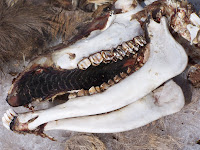
It was a hard winter for the deer and elk. There are signs of winterkill, bones left along the trail, pieces of shrunken, torn hide. The coyotes have been scavenging. Most deer and elk die from hunger and the cold, a few from mountain lions and poachers. Coyotes don't do most of the killing, but much of the cleanup. The Navajo say, "Coyote waits. And coyote is always hungry." They are opportunistic, just like us.

A tuff old jock offers this poem for you:

Ah...Spring
Skunks, birds, sage,
the snow reveals its bones.
The Great Wheel of Birth and Death
turns silently again,
my running shoes are muddy.
PS: Go to tuff old jock on Facebook and join the tuff old jock group. It's painless and free. You will find exhilaration, inspiration and motivation.

Intro to "The Lion Crossing"-


The Lion Crossing--Part I


A few times a week, I run up an old mining road that climbs along the flank of a rocky hogback. It’s the kind of place most people drive by without a glance because they are bound for aspen and alpine lakes on the Flat Tops ten miles away. The hogback is scarred by the road zigzagging up, and here and there, mine tailings spilling down its face. On a map, the road doesn’t seem to go anywhere. But it does, climbing through oak, sage, juniper, currants and feather bush, past an abandoned mine, around cliffs and outcrops, and along edges of deep ravines cutting through layers of red sandstone and grey shale. Three miles and a thousand vertical feet later, it arrives at a summit where you see mountains in every direction.

My dog goes with me on these runs. He’s a Red Siberian Husky, Golden Retreiver, Chow mix named Zorro, the Spanish word for fox, an apt name because his deep orange fur makes him look like a fox on steriods. He weighs 70 pounds, but thick fur creates the illusion he is much larger. If you don’t know him, he can seem detached and menacing.

When running, most of the time I keep my eyes down, scanning a few feet ahead for ruts and rocks to avoid tripping on my face, or in a couple of places, falling down the mountain. Occasionally I pause to enjoy the vista of the valley below. But most of the time I’m looking at what is right in front of me. It would be a problem to break an ankle here. Except for a couple months during hunting season, the road is deserted. Once in a while a 4-wheeler passes through, but I don’t see them because I usually go up with Zorro at sunrise.

A couple of Novembers ago, we were a mile up the trail after a rain-snow mix had fallen the night before. I was savoring the cool air and sweet smell of damp sage when Zorro yanked me sideways to sniff some animal tracks. He was on a leash because when he’s in hyper-aroused hunting mode, as he always is in this wild place, he’ll try to chase anything that runs. If he were loose, he’ll run for hours, forgetting altogether about time, and that here he is not on the top of the food chain.

I stopped to take a closer look at the tracks he’d found - large, round…four toes spread widely apart and shaped like asymmetric teardrops…clawless…a distinctive v-shaped heel pad - mountain lion. It’s paws had left perfect impressions in the wet clay. The lion had come down out of the sage, turned to look down the road in the direction from which we’d come, then cross the road back into the sage, headed towards the valley below. The tracks were very fresh, with crisp edges and water just beginning to well in the bottom of the impressions. Likely, it’d been there only minutes before we arrived. It might have stopped because it heard us coming or caught our scent. Zorrro sniffed around as I looked across a large open area covered with sage, but I saw nothing.

Coaxing Zorro with the leash, I aligned him parallel to the tracks, placing his rear foot even with the lion’s. The lion was almost a foot longer than he was. Then I placed Zorro’s rear foot into the lion’s rear print. It was over 3 times larger than his. The thought of how large that cat must be sent a chill through my body. Once again, I peered across the sage, still deserted, and we continued on our way.

Over the years, I’ve run, biked and hiked on lots of roads, paths and game trails in marquee wilderness areas and national parks, and less popular places in the boondocks, like this hogback. Only a couple of times had I come across lion tracks.

The following April we were on the mining trail, less than a half mile to the top. I was jogging slowly, gazing down on the ranch in the sprawling valley below. The cottonwoods that line the stream flowing out of the Flat Tops were already tinged with pale green buds. The stream, just starting to swell with runoff, glittered as it made lazy turns through the pastures. Suddenly Zorro stopped, his eyes trained up the hillside to the left. They say dogs don’t have very good eyesight, but he has an infallible eye for movement. Four legged and sure footed, as he climbs his head rotates back and forth like a radar dish. Once he stepped over a large bullsnake that was right under his feet because it remained perfectly still. But if something moves, he locks on it. He’s pointed me to deer, elk, coyotes, fox, even birds of prey circling overhead.

I stopped too, and followed his line of sight just in time to see the hindquarter of a tawny-colored animal slip behind a clump of juniper a little less than 100 yards away. It had a long tail and was too big to be a coyote. Something about the way it moved was different than other animals I’d seen. We both kept watching, and a few seconds later it came out the other side, then turned and looked at us. The stubby ears and angular face were unmistakable. After several seconds, the lion turned and bounded rapidly up the hill and out of sight. I wished it had waited just a few more seconds so I could study it before it ran away, but it should have been no surprise because mountain lions are supposed to be furtive and shy.

After thousands of miles in running and biking in the back country, I had finally seen a mountain lion in the wild. And it would not be the last.